概述: hashmap差不多是由链表组成的数组,当添加一个元素(key-value)时,就首先计算元素key的hash值,以此确定插入数组中的位置。当hash值相同时就放在已存在元素的后面形成链表,当链表长度太大时,链表就转换为红黑树。当链表数组的容量超过初始容量的0.75时,再散列将链表数组扩大2倍,把原链表数组的搬移到新的数组中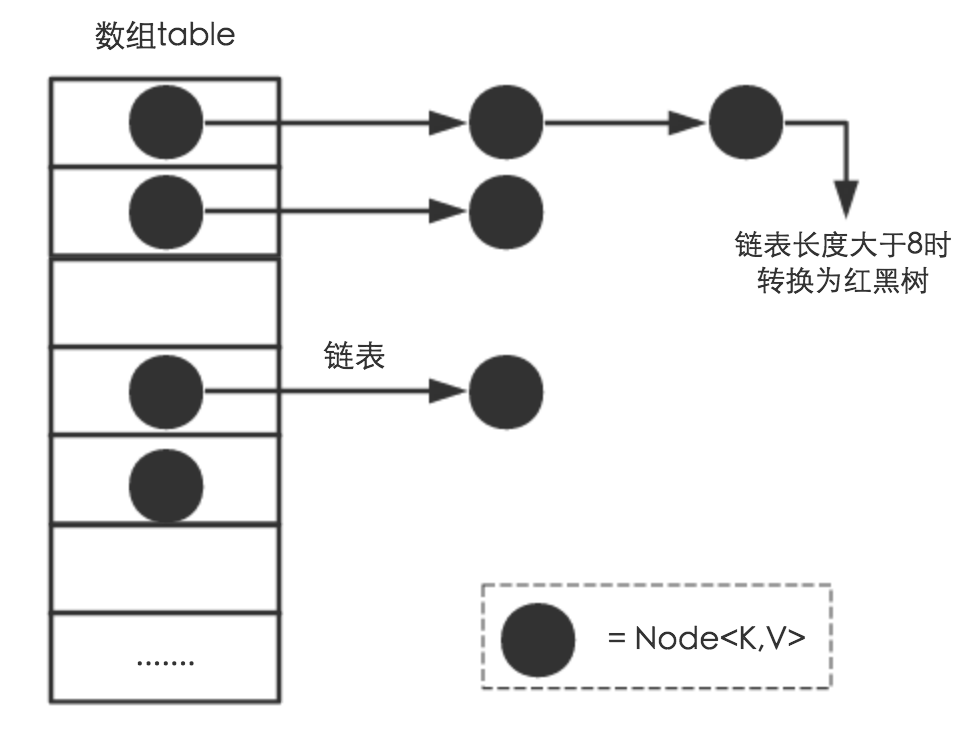
JDK1.8中的涉及到的数据结构
位桶数组
transient Node<k,v>[] table;//存储(位桶)的数组</k,v>
数组元素Node<K,V>实现了Entry接口
//Node是单向链表,它实现了Map.Entry接口
static class Node<k,v> implements Map.Entry<k,v> {
    final int hash;
    final K key;
    V value;
    Node<k,v> next;

    //构造函数Hash值 键 值 下一个节点
    Node(int hash, K key, V value, Node<k,v> next) {
        this.hash = hash;
        this.key = key;
        this.value = value;
        this.next = next;
    }

    public final K getKey()        { return key; }
    public final V getValue()      { return value; }
    public final String toString() { return key + = + value; }

    public final int hashCode() {
        return Objects.hashCode(key) ^ Objects.hashCode(value);
    }

    public final V setValue(V newValue) {
        V oldValue = value;
        value = newValue;
        return oldValue;
    }
    //判断两个node是否相等,若key和value都相等,返回true。可以与自身比较为true
    public final boolean equals(Object o) {
        if (o == this)
            return true;
        if (o instanceof Map.Entry) {
            Map.Entry<!--?,?--> e = (Map.Entry<!--?,?-->)o;
            if (Objects.equals(key, e.getKey()) &&
                Objects.equals(value, e.getValue()))
                return true;
        }
        return false;
    }
红黑树
static final class TreeNode<k,v> extends LinkedHashMap.Entry<k,v> {
    TreeNode<k,v> parent;  // 父节点
    TreeNode<k,v> left; //左子树
    TreeNode<k,v> right;//右子树
    TreeNode<k,v> prev;    // needed to unlink next upon deletion
    boolean red;    //颜色属性
    TreeNode(int hash, K key, V val, Node<k,v> next) {
        super(hash, key, val, next);
    }

    //返回当前节点的根节点
    final TreeNode<k,v> root() {
        for (TreeNode<k,v> r = this, p;;) {
            if ((p = r.parent) == null)
                return r;
            r = p;
        }
HashMap的构造函数
public HashMap(int initialCapacity, float loadFactor) {
    //指定的初始容量非负
    if (initialCapacity < 0)
        throw new IllegalArgumentException(Illegal initial capacity: initialCapacity);
    //如果指定的初始容量大于最大容量,置为最大容量
    if (initialCapacity > MAXIMUM_CAPACITY)
        initialCapacity = MAXIMUM_CAPACITY;
    //填充比为正
    if (loadFactor <= 0 || Float.isNaN(loadFactor))
        throw new IllegalArgumentException(Illegal load factor:  +
                                           loadFactor);
    this.loadFactor = loadFactor;
    this.threshold = tableSizeFor(initialCapacity);//新的扩容临界值
}

//构造函数2
public HashMap(int initialCapacity) {
    this(initialCapacity, DEFAULT_LOAD_FACTOR);
}

//构造函数3
public HashMap() {
    this.loadFactor = DEFAULT_LOAD_FACTOR; // all other fields defaulted
}

//构造函数4用m的元素初始化散列映射
public HashMap(Map<!--? extends K, ? extends V--> m) {
    this.loadFactor = DEFAULT_LOAD_FACTOR;
    putMapEntries(m, false);
}
HashMap的存取
HashMap如何getvalue值
get(key)方法时获取key的hash值,计算hash&(n-1)得到在链表数组中的位置first=tab[hash&(n-1)],先判断first的key是否与参数key相等,不等就遍历后面的链表找到相同的key值返回对应的Value值即可
public V get(Object key) {
        Node<K,V> e;
        return (e = getNode(hash(key), key)) == null ? null : e.value;
    }
      /**
     * Implements Map.get and related methods
     *
     * @param hash hash for key
     * @param key the key
     * @return the node, or null if none
     */
    final Node<K,V> getNode(int hash, Object key) {
        Node<K,V>[] tab;//Entry对象数组
    Node<K,V> first,e; //在tab数组中经过散列的第一个位置
    int n;
    K k;
    /*找到插入的第一个Node,方法是hash值和n-1相与,tab[(n - 1) & hash]*/
    //也就是说在一条链上的hash值相同的
        if ((tab = table) != null && (n = tab.length) > 0 &&(first = tab[(n - 1) & hash]) != null) {
    /*检查第一个Node是不是要找的Node*/
            if (first.hash == hash && // always check first node
                ((k = first.key) == key || (key != null && key.equals(k))))//判断条件是hash值要相同,key值要相同
                return first;
      /*检查first后面的node*/
            if ((e = first.next) != null) {
                if (first instanceof TreeNode)
                    return ((TreeNode<K,V>)first).getTreeNode(hash, key);
                /*遍历后面的链表,找到key值和hash值都相同的Node*/
                do {
                    if (e.hash == hash &&
                        ((k = e.key) == key || (key != null && key.equals(k))))
                        return e;
                } while ((e = e.next) != null);
            }
        }
        return null;
    }
HashMap如何put(key,value)
- 判断键值对数组tab[]是否为空或为null,否则以默认大小resize();
- 根据键值key计算hash值得到插入的数组索引i,如果tab[i]==null,直接新建节点添加,否则转入3
- 判断当前数组中处理hash冲突的方式为链表还是红黑树(check第一个节点类型即可),分别处理
public V put(K key, V value) {
        return putVal(hash(key), key, value, false, true);
    }
     /**
     * Implements Map.put and related methods
     *
     * @param hash hash for key
     * @param key the key
     * @param value the value to put
     * @param onlyIfAbsent if true, don't change existing value
     * @param evict if false, the table is in creation mode.
     * @return previous value, or null if none
     */
final V putVal(int hash, K key, V value, boolean onlyIfAbsent,
                   boolean evict) {
        Node<K,V>[] tab;
    Node<K,V> p;
    int n, i;
        if ((tab = table) == null || (n = tab.length) == 0)
            n = (tab = resize()).length;
    /*如果table的在(n-1)&hash的值是空,就新建一个节点插入在该位置*/
        if ((p = tab[i = (n - 1) & hash]) == null)
            tab[i] = newNode(hash, key, value, null);
    /*表示有冲突,开始处理冲突*/
        else {
            Node<K,V> e;
        K k;
    /*检查第一个Node,p是不是要找的值*/
            if (p.hash == hash &&((k = p.key) == key || (key != null && key.equals(k))))
                e = p;
            else if (p instanceof TreeNode)
                e = ((TreeNode<K,V>)p).putTreeVal(this, tab, hash, key, value);
            else {
                for (int binCount = 0; ; ++binCount) {
        /*指针为空就挂在后面*/
                    if ((e = p.next) == null) {
                        p.next = newNode(hash, key, value, null);
               //如果冲突的节点数已经达到8个,看是否需要改变冲突节点的存储结构,
            //treeifyBin首先判断当前hashMap的长度,如果不足64,只进行
                        //resize,扩容table,如果达到64,那么将冲突的存储结构为红黑树
                        if (binCount >= TREEIFY_THRESHOLD - 1) // -1 for 1st
                            treeifyBin(tab, hash);
                        break;
                    }
        /*如果有相同的key值就结束遍历*/
                    if (e.hash == hash &&((k = e.key) == key || (key != null && key.equals(k))))
                        break;
                    p = e;
                }
            }
    /*就是链表上有相同的key值*/
            if (e != null) { // existing mapping for key,就是key的Value存在
                V oldValue = e.value;
                if (!onlyIfAbsent || oldValue == null)
                    e.value = value;
                afterNodeAccess(e);
                return oldValue;//返回存在的Value值
            }
        }
        ++modCount;
     /*如果当前大小大于门限,门限原本是初始容量*0.75*/
        if (++size > threshold)
            resize();//扩容两倍
        afterNodeInsertion(evict);
        return null;
    }
HashMap的扩容机制resize()
构造hash表时,如果不指明初始大小,默认大小为16(即Node数组大小16),如果Node[]数组中的元素达到(填充比*Node.length)容量的0.75时,重新调整HashMap大小 变为原来2倍大小,扩容很耗时
final Node<K,V>[] resize() {
        Node<K,V>[] oldTab = table;
        int oldCap = (oldTab == null) ? 0 : oldTab.length;
        int oldThr = threshold;
        int newCap, newThr = 0;

    /*如果旧表的长度不是空*/
        if (oldCap > 0) {
            if (oldCap >= MAXIMUM_CAPACITY) {
                threshold = Integer.MAX_VALUE;
                return oldTab;
            }
    /*把新表的长度设置为旧表长度的两倍,newCap=2*oldCap*/
            else if ((newCap = oldCap << 1) < MAXIMUM_CAPACITY &&
                     oldCap >= DEFAULT_INITIAL_CAPACITY)
          /*把新表的门限设置为旧表门限的两倍,newThr=oldThr*2*/
                newThr = oldThr << 1; // double threshold
        }
     /*如果旧表的长度的是0,就是说第一次初始化表*/
        else if (oldThr > 0) // initial capacity was placed in threshold
            newCap = oldThr;
        else {               // zero initial threshold signifies using defaults
            newCap = DEFAULT_INITIAL_CAPACITY;
            newThr = (int)(DEFAULT_LOAD_FACTOR * DEFAULT_INITIAL_CAPACITY);
        }


        if (newThr == 0) {
            float ft = (float)newCap * loadFactor;//新表长度乘以加载因子
            newThr = (newCap < MAXIMUM_CAPACITY && ft < (float)MAXIMUM_CAPACITY ?
                      (int)ft : Integer.MAX_VALUE);
        }
        threshold = newThr;
        @SuppressWarnings({"rawtypes","unchecked"})
    /*下面开始构造新表,初始化表中的数据*/
        Node<K,V>[] newTab = (Node<K,V>[])new Node[newCap];
        table = newTab;//把新表赋值给table
        if (oldTab != null) {//原表不是空要把原表中数据移动到新表中
            /*遍历原来的旧表*/
            for (int j = 0; j < oldCap; ++j) {
                Node<K,V> e;
                if ((e = oldTab[j]) != null) {
                    oldTab[j] = null;
                    if (e.next == null)//说明这个node没有链表直接放在新表的e.hash & (newCap - 1)位置
                        newTab[e.hash & (newCap - 1)] = e;
                    else if (e instanceof TreeNode)
                        ((TreeNode<K,V>)e).split(this, newTab, j, oldCap);
    /*如果e后边有链表,到这里表示e后面带着个单链表,需要遍历单链表,将每个结点重*/
                    else { // preserve order保证顺序
                    ////新计算在新表的位置,并进行搬运
                        Node<K,V> loHead = null, loTail = null;
                        Node<K,V> hiHead = null, hiTail = null;
                        Node<K,V> next;

                        do {
                            next = e.next;//记录下一个结点
              //新表是旧表的两倍容量,实例上就把单链表拆分为两队,
              //e.hash&oldCap为偶数一队,e.hash&oldCap为奇数一对
                            if ((e.hash & oldCap) == 0) {
                                if (loTail == null)
                                    loHead = e;
                                else
                                    loTail.next = e;
                                loTail = e;
                            }
                            else {
                                if (hiTail == null)
                                    hiHead = e;
                                else
                                    hiTail.next = e;
                                hiTail = e;
                            }
                        } while ((e = next) != null);

                        if (loTail != null) {//lo队不为null,放在新表原位置
                            loTail.next = null;
                            newTab[j] = loHead;
                        }
                        if (hiTail != null) {//hi队不为null,放在新表j+oldCap位置
                            hiTail.next = null;
                            newTab[j + oldCap] = hiHead;
                        }
                    }
                }
            }
        }
        return newTab;
    }
JDK1.8使用红黑树的改进
在jdk8中,HashMap处理“碰撞”增加了红黑树这种数据结构,当碰撞结点较少时,采用链表存储,当较大时(>8个),采用红黑树存储
- 有一个阀值控制,大于阀值(8个),将链表存储转换成红黑树存储
手写简易版HashMAp
package org.kang.entity;

public interface MyMap<K, V> {
    V put(K key, V value);

    V get(K key);

    interface Entry<K,V>{
        V setValue(V value);
        Entry<K,V> setNext(Entry<K,V> entry);
    }
}
package org.kang.entity;

public class MyHashMap<K, V> implements MyMap<K, V> {
    //定义了一个存Node<K,V>的数组
    private Node<K, V> table[] = null;
    //数组元素个数
    private int size;
    //数组默认长度
    private static int defaultCapacity = 1 << 4;
    //默认的加载因子
    private static float defaultLoadFactor = 0.75f;
    private int threshold;

    private MyHashMap() {
        threshold = (int) (defaultCapacity * defaultLoadFactor);
    }

    @Override
    public V put(K key, V value) {
        if (table == null) {
            table = new Node[this.defaultCapacity];
        }
        //通过hsah算法,得到index值
        int index = getIndex(key, this.table.length);
        //判断是否是修改
        Node<K, V> node = table[index];
        for (; node != null; node = node.next) {
            if (node.key == key || (node.key != null && node.key.equals(key))) {
                return node.setValue(value);
            }
        }
        //扩容
        if (size >= threshold) {
            resize();
        }
        //创建Node元素,并存放在table的index位置
        table[index] = new Node<>(key, value, table[index]);
        ++size;
        return null;
    }

    @Override
    public V get(K key) {
        if (table != null) {
            int index = getIndex(key, this.table.length);
            Node<K, V> node = table[index];
            for (; node != null; node = node.next) {
                if (node.key == key || (node.key != null && node.key.equals(key))) {
                    return node.value;
                }
            }
        }
        return null;
    }

    //扩容,重新散列  消耗空间及时间
    private void resize() {
        Node<K, V> newTable[] = new Node[table.length << 1];
        //循环数组
        for (int i = 0; i < table.length; i++) {
            Node<K, V> node = table[i];
            //循环链表
            for (; node != null; ) {
                //Key在新的数组上的位置 ,重新进行哈希计算
                int index = getIndex(node.key, newTable.length);
                Node<K, V> oldNode = node.next;
                node.next = newTable[index];
                newTable[index] = node;
                node = oldNode;
            }
        }
        table = newTable;
        this.defaultCapacity = newTable.length;
        threshold = (int) (defaultCapacity * defaultLoadFactor);
    }

    private int getIndex(K key, int length) {
        if (key == null) {
            return 0;
        }
        return key.hashCode() & (length - 1);
    }

    //链表
    static class Node<K, V> implements Entry<K, V> {
        K key;
        V value;
        Node<K, V> next;

        public Node(K key, V value, Node<K, V> next) {
            this.key = key;
            this.value = value;
            this.next = next;
        }

        @Override
        public V setValue(V value) {
            V oldValue = this.value;
            this.value = value;
            return oldValue;
        }

        @Override
        public Entry<K, V> setNext(Entry<K, V> entry) {
            Entry<K, V> oldEntry = this.next;
            this.next = (Node<K, V>) entry;
            return oldEntry;
        }
    }
}